
 |
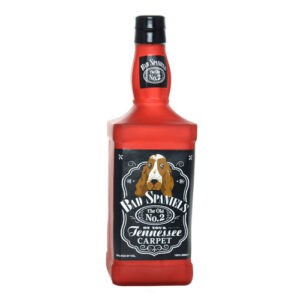 |
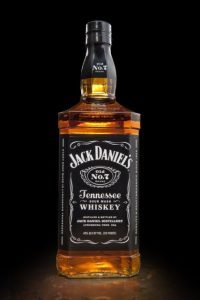
| Bottle of Jack Daniels | Bad Spaniels Squeaky Toy |
Jack Daniel’s iconic bottle design is an example of a famous trade dress, which is registered as a trademark. A trademark is a type of intellectual property that includes a logo, symbol, phrase, word, name, or design that is used to identify products or services of a particular source from those of other sources. Trade dress is a type of trademark that protects all elements used to promote a specific service or product. Examples of trade dress may include packaging of a product, the shape and color of a product or the décor of a place of business.
VIP Products sold dog toys, including one called “Bad Spaniels”, which was introduced in 2013 and mimicked Jack Daniel’s trade dress. The toy (pictured above) is generally shaped like the Jack Daniel’s bottle with some notable differences. For example, the toy has an image of a spaniel over the words “Bad Spaniels.” The Jack Daniel’s label says, “Old No. 7 Brand Tennessee Sour Mash Whisky,” while the toy’s label jokingly says, “the Old No.2, on your Tennessee Carpet.” Further, the toy includes a tag which states that the “product is not affiliated with Jack Daniel’s Distillery.”
Jack Daniel’s sent a cease and desist letter to VIP, which has resulted in a more than a decade-long legal battle, including the 2023 Supreme Court case of Jack Daniel’s Properties v. VIP Products LLC, 599 U.S. 140 (2023). At the Supreme Court, Jack Daniel sued VIP for both trademark infringement and dilution by tarnishment under the Lanham Act. In a typical trademark infringement case, the issue is whether the use of an allegedly infringing mark is likely to cause confusion. In a typical dilution case, the issue is whether the offending mark has harmed the reputation of a famous trademark.
VIP argued that its toy was a parody that joking mimicked Jack Daniel’s trade dress and was, therefore, free speech that was protected by the first amendment. As such, VIP reasoned that they were entitled to first amendment defenses under the long standing “Rogers” test (Ginger Rogers v. Alberto Grimaldi, 875 F. 2d 994 (2nd Circuit, 1989)). Under the Rogers test, a defendant accused of trademark infringement must first come forward and make a threshold legal showing that its allegedly infringing use is part of an expressive work protected by the First Amendment. If a defendant can make that showing, then the plaintiff claiming trademark infringement bears a heightened burden, wherein the plaintiff must satisfy not only the likelihood of confusion test but also at least one of the two prongs of the Rogers test. That is, the plaintiff must then show that the mark is “either not artistically relevant to the underlying work or explicitly misleads consumers as to the source or content of the work.”
The Supreme Court’s landmark ruling in this case helped to further define the boundaries of trademark law when it comes to parodies that are sold as commercial products. More specifically, the Supreme Court ruled that the Rogers test does not apply when an alleged infringer used a mark as a designation of source for their own goods and that the traditional “likelihood of confusion” and “dilution by tarnishment” analysis must apply. The Supreme Court then remanded the case to the US District Court for the District of Arizona.
In VIP Products LLC v. Jack Daniel’s Properties Inc., Case No. CV-14-02057-PHX-SMM, 2025 WL 275909 (January 21, 2025), the District Court found on remand that VIP’s “Bad Spaniels” dog toy was a “successful parody” of a famous mark. That is, the toy conjures up the original, yet creates contrasts, so that its message of ridicule or pointed humor becomes clear, and, therefore, is not often likely to create confusion. However, in spite of being a successful parody, the District Court also ruled that VIP had violated the Lanham Act through dilution by tarnishment.
The District Court found that “the qualities on which ‘Bad Spaniels’ runs afoul of the Lanham Act’s cause of action for dilution by tarnishment are the very qualities that help “Bad Spaniels” to prevail on a trademark infringement claim, as they are the qualities that create contrasts with Jack Daniel’s mark by way of irreverent juxtaposition.” Citing the treatise “McCarthy on Trademarks and Unfair Competition” the District Court observed that, “[t]he irony is that the more distasteful and crude the parody, the less likely it is that the public will mistakenly think that the trademark owner has sponsored or approved it.”
The court went on to conclude that “Bad Spaniels finds itself in the category of a non-confusing parody product that is nonetheless impermissible under the Lanham Act’s cause of action for tarnishment. This divergent result arises because the considerations under the Lanham Act’s cause of action for trademark infringement and trademark dilution are distinct; liability for trademark infringement protects the prior user of a mark from the potential diversion of trade or harm to reputation that results when purchasers are confused as to the source or sponsorship of goods or services bearing the mark whereas “antidilution statutes protect against … dilution of the distinctiveness and the selling power of a mark.”
Accordingly, even a non-confusing parody can violate the Lanham Act if it harms a famous mark’s reputation through negative associations. Even though VIP created a successful parody in its “Bad Spaniels” toy and was able to avoid trademark infringement, the excessively “irreverent” nature (for example, the associating of whiskey to excrement) is what made VIP vulnerable to a dilution claim.
The takeaway from the above cases is that parodists must balance the degree of irreverence in the humor expressed in the parody with the amount of harm that may be caused to the reputation of a famous mark. Ironically, the more famous the mark, the greater the risk of harm that may be claimed. At the moment, it appears to be relatively safe to parody a trademark on a consumer product that does not directly compete, so long as the degree of humor is tasteful.
Stephen P. Scuderi is an associate with the law firm of Heslin Rothenberg Farley & Mesiti P.C. His practice involves all phases of intellectual property law, including the drafting of hundreds of patents in the electrical and mechanical arts. Stephen can be reached at (518) 452-5600 or at .